Where the cards came from
China, the Mongols, Egypt, Venice, Persia, India. Nobody saw cards being invented, so the story is a detective case.
- Region
- From China to Europe, Iran and India
- Court
- Mongol, Mamluk, Timurid and Safavid
- Period
- About 1000 to 1700
Who invented cards
Here is a puzzle with no witness. Somebody, somewhere, painted the first pack of playing cards. Nobody wrote down who.
So people guessed. Over about 275 years of books on cards, the prize for “inventor” has been handed to China, India, Egypt, the Netherlands, Spain, Italy, Germany and France. That is a lot of inventors for one pack.1
Some guesses were careful. Some were wild. A historian called Detlef Hoffman, who surveyed this long debate, found real scholarship sharing the table with magic, national pride and amateur guesswork.1
Two English writers, Willshire and Morley, once thought the old Italian suit signs were hiding in a picture of the Hindu god Shiva: his drum became the cup, his trident the staff. Their picture was not even accurate. Von Leyden adds, with a straight face, that the god Vishnu would have suited their theory better.1
Others tried to grow cards out of chaturanga, an Indian dice-chess for four players.1 And von Leyden is very clear about one thing: his book does not claim that India invented cards.1
So everything below is a theory. Read it like a detective story, not a history test.
Paper money and the Mongols
Picture a banknote. Now picture a card. Flat, printed, passed from hand to hand. Not so different.
The Chinese had playing cards before the year 1000. Later, a popular kind of Chinese card looked like money. Nobody knows if these “money cards” existed as early as the 1200s. If they really were copied from paper money, von Leyden thinks an early date becomes a bit more likely.1
His theory runs like this. In the 1200s the Mongols conquered a huge stretch of the world, and roads opened between China, Central Asia, Western Asia and the Mediterranean. Chinese money cards may have travelled west along them.1
There is one real clue. The Mongol rulers of Iran, the Ilkhans, had run out of money. In 1294, Chinese settlers in the city of Tabriz printed paper money for them. Von Leyden thinks local people may have picked up Chinese card games at the same time. That last part is his guess.1 His timeline starts with Mongol paper money of 1287, copied from older Chinese notes.4
Then the cards may have changed their clothes. Chess was already a favourite game, and von Leyden suggests it may have lent the pack its two great figures: the shah, the king, and the wazir, his minister.1
Egypt, Venice and Europe
The next stop in the story is Egypt and Syria, ruled by the Mamluks.
Von Leyden thinks a version of the card game had reached the Mamluks before 1300, perhaps through southern Russia, where many Mamluk soldiers were recruited.1 Pieces of Mamluk cards from about 1300 survive in Egypt. The Mamluks called the game kanjafah. Hear the echo of ganjifa?4
A Mamluk pack had four suits of thirteen cards, with three court cards in each suit.3 The suits copied the offices of the court: the guard, the treasury, and even the master of polo, the jukandar. Their badges still decorate Mamluk buildings.1
Then, the theory says, the Venetians learned the game from the people they called “Saracens” and sailed it to Italy. It spread astonishingly fast. Italy first mentions cards in 1376–77, and calls them naibi.14 By the end of the 1300s, cards were known almost everywhere.1
Michael Dummett, who wrote the book’s chapter on how ganjifa is played, says this idea, that cards reached Europe from Mamluk Egypt in the late 1300s, had become fairly widely accepted.5
There is a lovely money clue too. Every one of these old packs has a suit named after a real local coin: the Mamluk dirham, the Italian denari, and in Iran the ashrafi (gold) and the tanka (silver).1
Four suits become eight
Now the story heads east again, to Iran and Central Asia, and gets bigger. Much bigger.
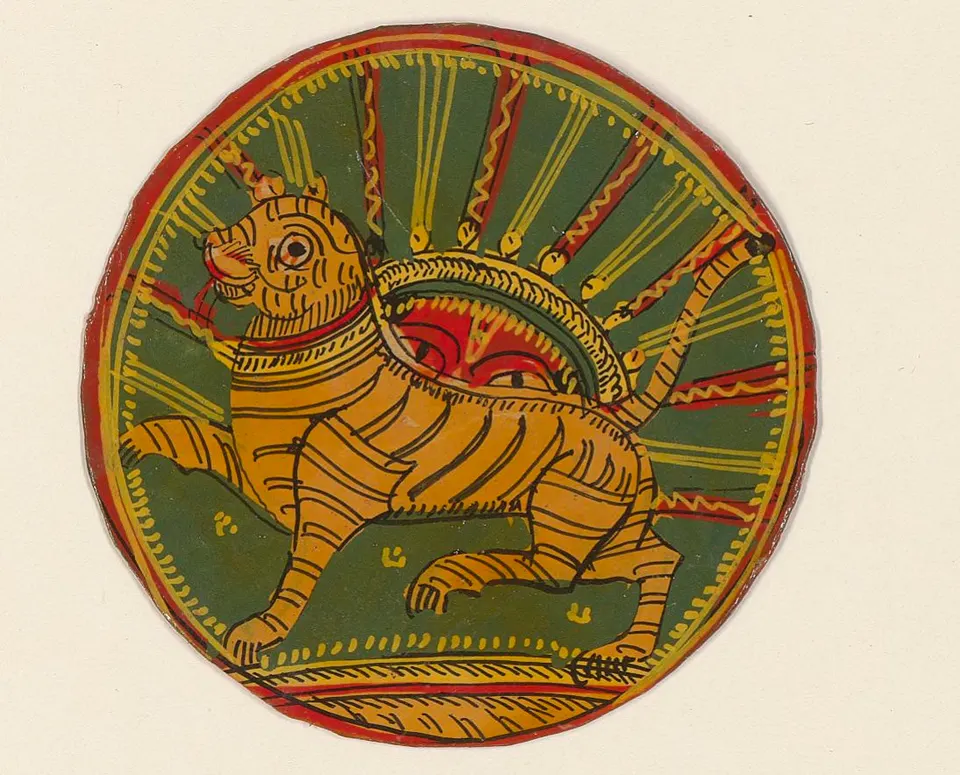
Mamluk and Italian packs had four suits. Ganjifa packs in Iran and India had eight. Von Leyden thinks the eight is most likely just the four, doubled.1
Why double a pack? Look at Timur, the great conqueror of the 1300s. He played chess on a board of 100 squares, crowded with extra pieces. Von Leyden suggests that, at courts that loved everything enlarged like this, a four-suit pack could easily swell into eight.1
By about 1500, the eight-suit pack of 96 cards turns up in Iran and in India, loved by the early Safavid shahs and the Mughal emperors.1
In 1514–15 a poet called Ahli Shirazi, probably living in Tabriz, wrote 96 short love poems, one for each card.1 He wrote them for Shah Isma’il, the first Safavid shah, who was presumably a keen player.1 The poems say almost nothing about how to play. But they are the oldest writing to name all eight suits: slave, crown, sword, gold coin, harp, document, silver coin and goods.14
A century later, a historian claimed that a Persian called Mansur Shirazi had “invented” ganjifa by copying a card game of the Europeans. The story was later doubted. Von Leyden still finds it interesting that people believed it.14
And Persia itself? The eight-suit game stayed popular there under Shah Abbas I (1587–1628). Then the stricter Shah Abbas II (1642–1667) stamped it out, and it vanished from Iran. India, not Persia, is where the game really grew up.2
One family tree
Here is Dummett’s big idea, and it is a theory too.
Imagine a lost grandparent pack from Iran or Central Asia: 48 cards, four suits, two court cards in each. Nobody has ever found one. Double it, and you get the 96-card ganjifa. Add a third court card to each suit, and you get the Mamluk pack, and from it Europe’s cards.5
His best clue is a strange habit. In every ganjifa game, the kings and ministers sit on top, but the number cards run one way in half the suits and the opposite way in the other half.5 Tarot and Ombre, old games of Italy and Spain, kept much the same habit.5
Dummett argues that a custom this odd could not have been invented twice. So Indian and European cards, he says, must share a very distant ancestor. And his clue comes from how the cards were played, not how they looked.5
Europe’s cards came much later to India by ship, too. In 1498 the Portuguese reached Calicut, and their sailors brought their own packs.1 But von Leyden is fairly confident that European cards played no part in shaping the eight-suit ganjifa. Its roots, he says, lie in Iran and Central Asia.1
So the next time you shuffle a pack, you may be holding a very distant cousin of an emperor’s round cards.
Sources
Written in our own words from these sources.
- Ganjifa: The Playing Cards of India, Rudolf von Leyden (Victoria & Albert Museum, 1981), pp. 5–8
- Ganjifa: The Playing Cards of India, Rudolf von Leyden (1981), p. 11
- Ganjifa: The Playing Cards of India, Rudolf von Leyden (1981), pp. 15–16
- Ganjifa: The Playing Cards of India, Rudolf von Leyden (1981), p. 41
- The game of ganjifa, Michael Dummett, appendix in von Leyden (1981), pp. 50–53
Image credits
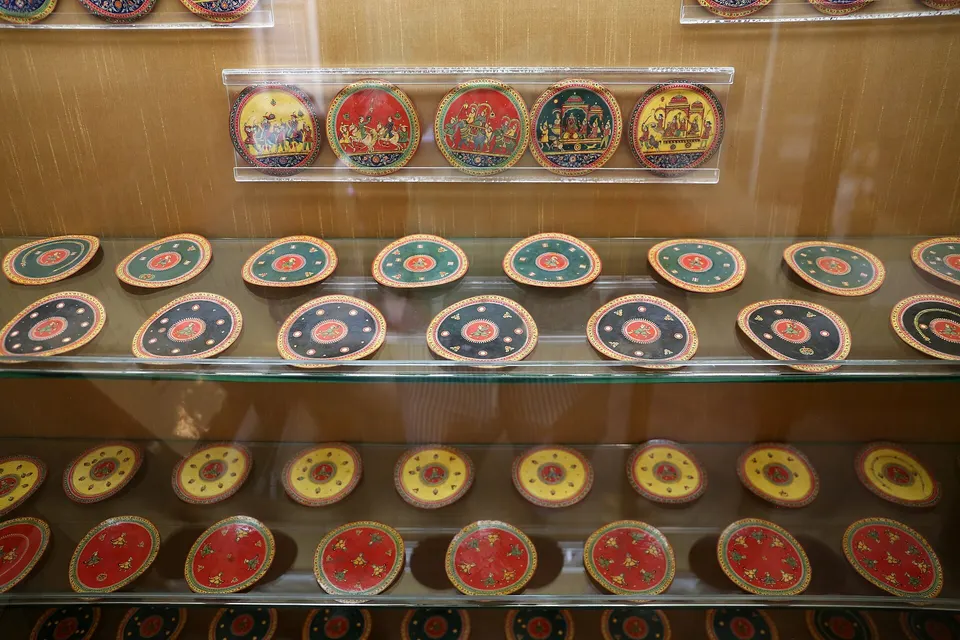
- Ganjifa packs on display, made between about 1890 and 1920. · Photo: Sailko, via Wikimedia Commons · CC BY 3.0
- (Ganjifa mogholes de forme ronde) (...) btv1b550073113 1 (1) · Bibliothèque nationale de France, Gallica btv1b550073113 · Public domain
- A King Handing a Royal Document to His Minister, King of the Barat (Document) Suit, Playing Card from a Mughal Ganjifa Set · Los Angeles County Museum of Art, M.73.55.9 · Public domain

_(...)_btv1b550073113_1_(1).jpg)
_Suit,_Playing_Card_from_a_Mughal_Ganjifa_Set_LACMA_M.73.55.9.jpg)