Dashavatar Ganjifa
Ten suits, ten faces of the god Vishnu. One writer even claimed the game could wash away your sins.
- Region
- Deccan, Maharashtra, Orissa, Bengal and beyond
- Court
- Hindu courts and Brahmin households
- Period
- Probably from the 1600s
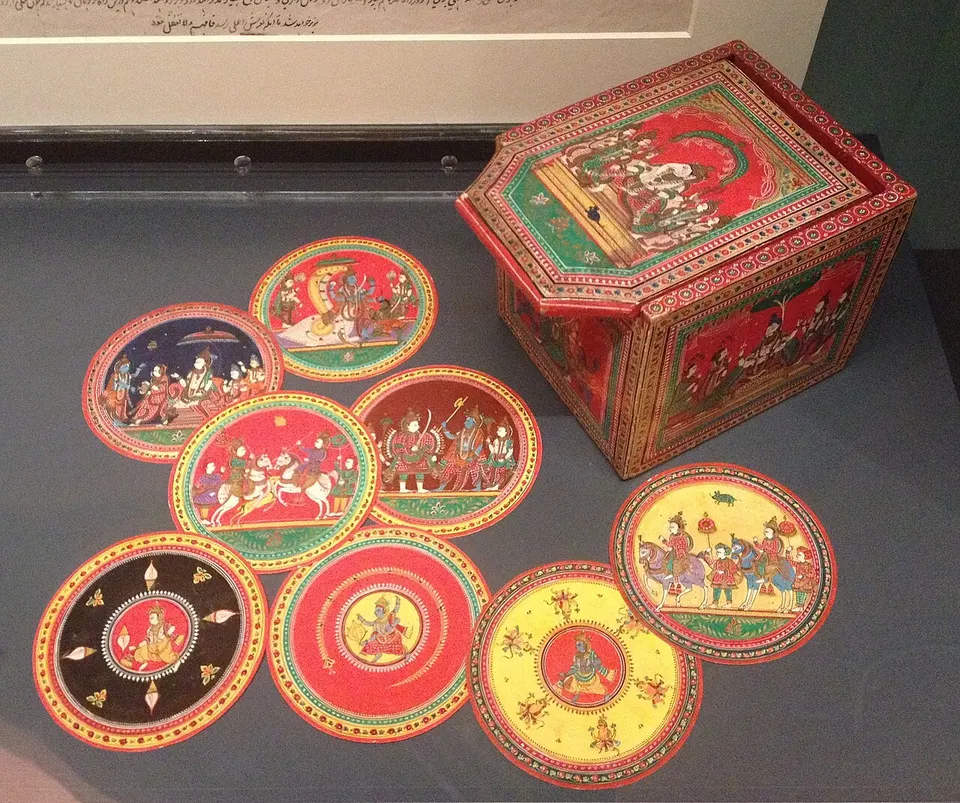
Origins
Take the Mughal emperor’s card game. Keep the round cards, keep the rules, keep the kings and ministers. Now swap the court for the gods.
That is Dashavatara ganjifa. Dasha means ten and avatar means a form a god takes when he comes down to earth. Hindu stories tell of ten such forms of the god Vishnu, and this pack gives each one a suit of its own.2
Nobody knows exactly where or when it began. Von Leyden thinks the Deccan in the 1600s is a very good guess, and old writings from Maharashtra point the same way.12 One clue is hiding in plain sight: many Dashavatara packs still have a minister riding a horse beside the king, just like a Mughal pack. A horseman fits a royal court far better than a story about gods, which suggests the Mughal game came first.2
It spread a long way: Bengal, Orissa, Nepal, Rajasthan, Karnataka, Maharashtra, Andhra Pradesh and Madhya Pradesh all played it.1 In Maharashtra, Brahmin scholars loved it so much that they wrote serious books about its rules.1
Meet the ten suits
Each suit tells a story. Here they are, in their usual order, with the picture you will find on the number cards:23
- Matsya, the fish. Vishnu bursts out of a giant fish’s open mouth. Sign: a fish.
- Kurma, the tortoise. He holds up a mountain while gods and demons churn the ocean for the drink of immortality. Sign: a tortoise.
- Varaha, the boar. He rescues the earth goddess from the underworld. Sign: a boar or a conch shell.
- Narasimha, half man and half lion. He defeats a wicked demon king. Sign: a lion or a spinning discus.
- Vamana, the dwarf. He asks a greedy king for just three steps of land, then grows so huge that three steps cover the whole world. Sign: an umbrella or a water pot.
- Parashurama, Rama with the axe. Sign: always an axe.
- Ramachandra, the hero Rama, who rescues Sita from the demon king of Lanka. Sign: a bow and arrow, or the monkeys who helped him.
- Krishna or Balarama, the two brothers. Balarama carries a plough; Krishna plays his flute. Signs: a plough, cows, or a discus.
- Buddha, who sits on a throne. Sign: a lotus or a conch.
- Kalkin, the one still to come: a rider on a white horse who will end this age so that a new one can begin. Sign: swords or horses.
Places did not always agree on the line-up. Depending on where you sat down to play, the eighth and ninth suits could be Balarama, Krishna, Buddha or Jagannatha, the form of Krishna worshipped at Puri.2
The cards
2 cards
- Buddha · Raja
- Rama · 4
How it was played
Underneath the gods, it is the same game as Mughal ganjifa, just bigger: ten suits of twelve cards instead of eight, so 120 cards in all.2
Each suit has a king (raja), a minister (mantri), and ten number cards. The first five suits are “weak”, where the ace is the strongest number. The last five are “strong”, where the ten is the strongest.2
And who starts? It depends on the clock, and on who you ask. Von Leyden says the king of Balarama or Krishna leads by day and the king of Ramachandra by night.2 A Marathi rulebook from 1884 says the king of Rama leads by day and the king of Krishna by night.3 Card players have always argued about the rules.
Bigger and bigger packs
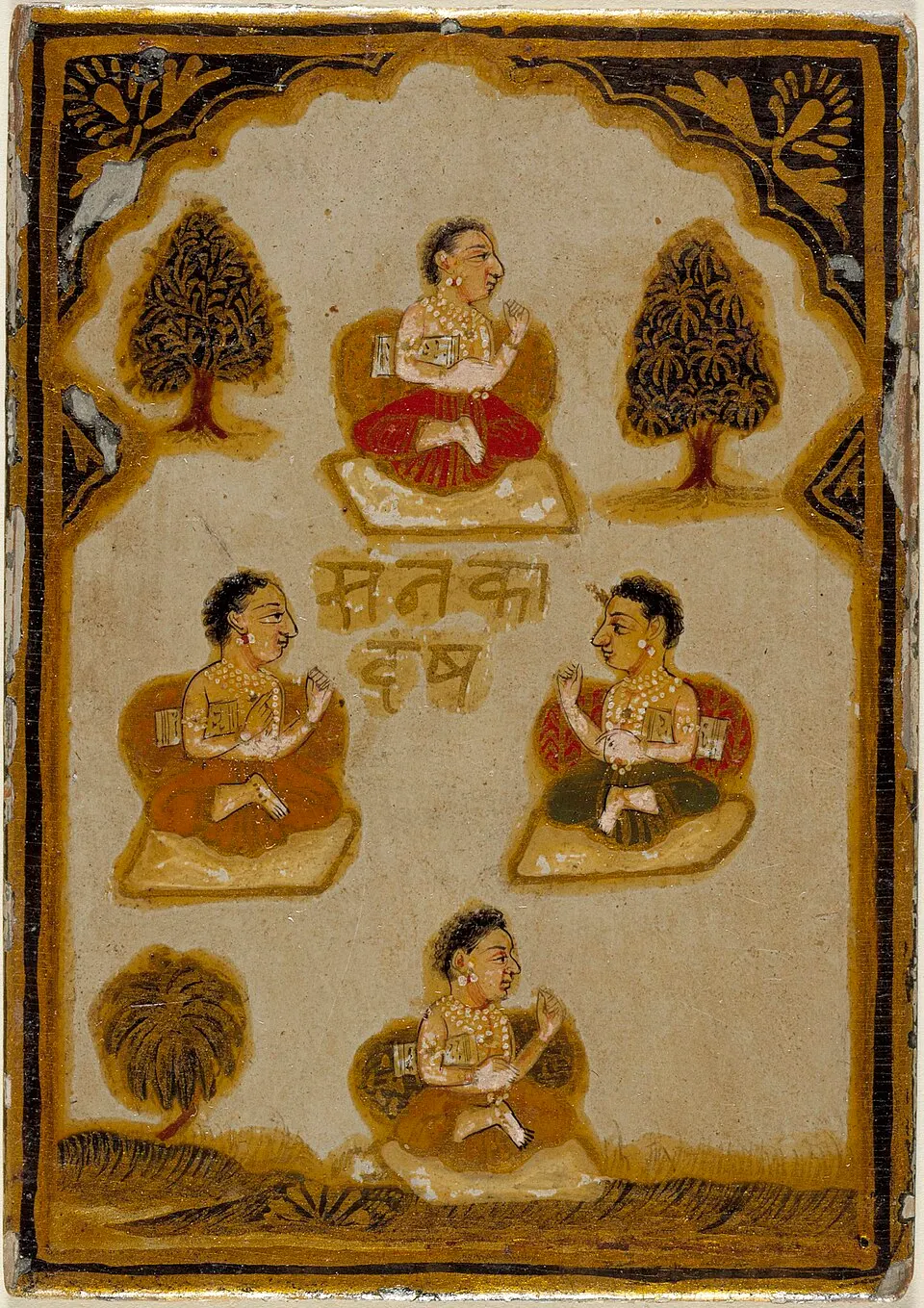
Players kept adding suits to make the game harder. In Orissa the pack grew to twelve suits with Ganesha and Skanda, then to sixteen or even twenty suits, and these giant packs were still being played when von Leyden wrote in 1981.2
In Sonepur, Orissa, card makers painted a twelve-suit Ramayana pack called ganjappa: six suits for Rama’s army against six for Ravana’s, a whole war fought across the card table.2
And in the palace of Mysore in the early 1800s, the king Krishnaraja III had his artists paint games with up to eighteen suits, so that a single pack could hold 360 cards. Von Leyden counts them among the finest Indian playing cards ever made.2
Sources
Written in our own words from these sources.
- Ganjifa: The Playing Cards of India, Rudolf von Leyden (Victoria & Albert Museum, 1981), pp. 14–15
- Ganjifa: The Playing Cards of India, Rudolf von Leyden (1981), pp. 21–26
- The game of ganjifa, Michael Dummett, appendix in von Leyden (1981), pp. 51–54
Image credits
- A Dashavatara ganjifa set from Sawantwadi, with its painted box. · Ashmolean Museum, Oxford, EAX.2078 · Photo: Marsupium · CC0
- Buddha · Raja · Los Angeles County Museum of Art, M.73.55.1 · Public domain
- Rama · 4 · Los Angeles County Museum of Art, M.73.55.4 · Public domain
- Four Monks, Number Four of the Sanaka (Ancient) Suit, Playing Card from a 32-Suit Dashavatara (Ten Avatars) Ganjifa Set · Los Angeles County Museum of Art, M.73.55.8 · Public domain

_Ganjifa_Set_LACMA_M.73.55.1.jpg)
_Ganjifa_Set_LACMA_M.73.55.4.jpg)
_Suit,_Playing_Card_from_a_32-Suit_Dashavatara_(Ten_Avatars)_Ganjifa_Set_LACMA_M.73.55.8.jpg)