Naqsh
Forget the long battle of tricks. Naqsh is a quick bet: build a lucky pattern of cards and scoop the pot.
- Region
- Rajasthan, Madhya Pradesh, Orissa, Bengal
- Court
- Festival tables, not palaces
- Period
- Dashehra to Diwali
A different kind of game
Imagine two people holding the very same round painted cards. One settles in for a long, careful game, remembering every card that falls. The other glances at a handful, shouts, and grabs a pile of coins. They are playing two completely different games.
Michael Dummett, who wrote the rules chapter at the back of the book, says ganjifa cards were used for two very different families of games. One family is ganjifa proper, the trick-taking game that usually just borrows the cards’ own name. The other family is naqsh.4
What does the word mean? Naqsh (also spelled naksha) means a design, a shape or a pattern. In the game it is the name for any combination of cards that wins.2
The word is old. Around 1600, a poet named Wasli, the older brother of the emperor Jahangir’s minister, wrote a long poem about the cards of an eight-suit pack. In his verses, too, a naqsh is a winning set of cards.3
How it is played
Naqsh is a gambling game, and a fast one. Von Leyden compares it to baccarat and to vingt-et-un, the card game whose name is French for “twenty-one”.2
Here is the heart of it. If the cards in your hand add up to 17 or 21, you take the stakes. Other patterns win you a slice of the pot instead: a pair, three of a kind, or pairs that come with aces.2
So there is no “command” card to remember, and no trick to lose. You just hope the right pattern lands in your hand.
An Indian scholar, Dr Kaushal Gupta, has written a detailed account of the game.2 Naqsh has rules of its own. Dummett’s appendix covers the trick-taking ganjifa game, not naqsh.34 Dummett expected Dr Gupta’s coming book to give the definitive history of the game.4
Packs made of copies
You do not need a special pack. Almost any standard pack will do, Indian or European. The book lists packs of 96, 84, 80, 48, 40 and 36 cards.2
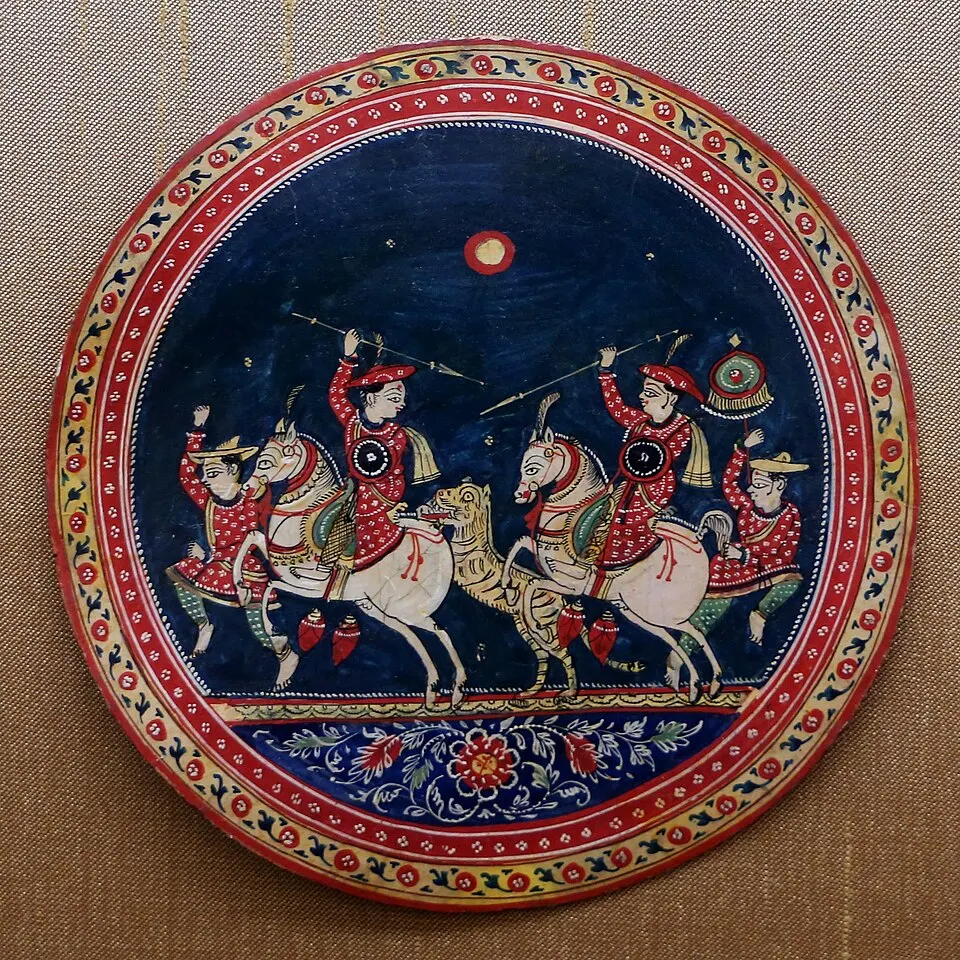
But some places made packs just for naqsh. In Rajasthan, Madhya Pradesh and Orissa (today spelled Odisha), a naqsh pack is built from 3, 4 or 8 identical series of twelve cards.2 Every series is a copy of the others:
- a mir, the king;
- a ghodi, “the mare”, which shows a horseman, much like the usual minister card;
- and ten number cards.
All of them share one colour and one suit sign, usually the sign of the safed (silver) or surkh (gold) suit.2 Imagine a pack where every suit is the same suit. It sounds like a printing mistake, but for naqsh it is the whole point.
In Orissa such one-colour packs have their own name: ekrang, which simply means “one colour”.2 (Orissa also has a separate game called ekrang, played by two teams of two.3)
In Bishnupur, in West Bengal, the naqsh pack has four matching suits. Its king rides an elephant and is called sahib. Its minister rides a horse and is called bibi, “the lady”. Von Leyden wonders if that name hints that the game came from abroad.2
Lucky season
When does India gamble most? In the festival season, from Dashehra to Diwali, in October or November. Naqsh and games like it are played above all then, under the care of Lakshmi, goddess of good fortune.2
People in India have loved gambling for a very, very long time, first with dice and later with cards.2
Where did a game of identical suits come from? Packs like this also turn up in Nepal, in Japan (where one is called kabu karuta), in Portugal and elsewhere in Europe. Von Leyden thinks the game very likely began either in the East or in the West, but he admits it is hard to say which.2 His guess is that Portuguese sailors probably carried it around South-East Asia and the shores of the Indian Ocean in the 1500s, and that it arrived in India that way.2
A royal mystery from 1545
On 12 November 1545, Gulbadan, the daughter of Babur, wrote down a game at her brother Humayun’s court. Twelve players each held 20 cards. Each one staked twenty copper coins called sharukhis, and the loser paid them over to the winner.1
Copper sounds cheap. Yet von Leyden works out that every player risked more than a pre-war British pound in a single round. The royal family was betting rather wildly.1
Now do the sum: twelve players times twenty cards is 240 cards. If Gulbadan got it right, that is a lot of cardboard. Von Leyden asks whether they were playing naqsh, with a ten-suit pack doubled, or using Chinese cards. He leaves the question open: nobody knows what the game was.1
Sources
Written in our own words from these sources.
- Ganjifa: The Playing Cards of India, Rudolf von Leyden (Victoria & Albert Museum, 1981), p. 11
- Ganjifa: The Playing Cards of India, Rudolf von Leyden (1981), p. 27
- Ganjifa: The Playing Cards of India, Rudolf von Leyden (1981), pp. 40–41
- The game of ganjifa, Michael Dummett, appendix in von Leyden (1981), pp. 50, 57
Image credits
- India, carte per giocare a ganjifa, 1890-1920 ca. 02 · Photo: Sailko, via Wikimedia Commons · CC BY 3.0
- (Ganjifa mogholes de forme ronde) (...) btv1b550073113 1 (1) · Bibliothèque nationale de France, Gallica btv1b550073113 · Public domain

_(...)_btv1b550073113_1_(1).jpg)