The Mysore palace games
A king who spent his life inventing card games, with eighteen suits, a goddess in charge and up to 360 cards a pack.
- Region
- Mysore, South India
- Court
- Krishnaraja III Odeyar
- Period
- Early 1800s
The king who loved card games
Some kings collect jewels. Some collect horses. Krishnaraja III Odeyar, who ruled Mysore in South India, collected something stranger: card games he made up himself.4
He lived from 1794 to 1868, and von Leyden says he gave his whole life to devising and making these games.2 Not just playing them now and then: inventing them, and having them made.
He even wrote them down. Early in the 1800s the king put together a giant book of knowledge called the Shritatwanidhi. Its very last chapter is the Kautukanidhi, which means “the treasure of games and pastimes”. In it he describes a whole set of complicated card games.4
Saving the games for the final chapter feels about right. First the serious learning, then the fun.
A pack the size of a pile of books
An ordinary Mughal ganjifa pack has 96 cards: eight suits of twelve.2
Krishnaraja’s packs were nothing like ordinary. Some of the games in the Kautukanidhi use six court cards in each suit instead of two, as many as twelve number cards, and up to eighteen suits. On top of that come extra loose cards that belong to no suit at all, called chakravarti. Add it all up and a single pack could hold 360 cards.4
Imagine dealing that. Imagine dropping it.
The games had a name of their own too: chhada.2 And for all their size, they were not a brand-new invention. The Kautukanidhi says plainly that they followed the usual ganjifa rules, with some local changes.4 Von Leyden counts all these Hindu packs as offshoots of the Mughal game, and the Kautukanidhi backs him up.4
A goddess at the head of the table
In a Mughal pack the suits are things from a palace: coins, crowns, swords. In Krishnaraja’s games, gods rule the suits.24
Not just a few gods, either. These packs are crowded with the many gods of the South Indian pantheon, meaning the whole family of gods worshipped in the south. Leading them all is Chamundeshvari, the guardian goddess of the Mysore royal family.4 So the king’s own protector sat at the head of his card table.
From the same time and place comes a round Mysore card of the early 1800s, the four of a suit called Mohini. The book does not say it belonged to the king’s own packs. It shows four women sitting around a cross-shaped board, playing chaupar, a race game with pieces. It is now in the Rietberg Museum in Zurich.1 So here is a playing card that shows people playing a completely different game.
The painters and the palace
Who painted 360 cards a pack? Not the king. Krishnaraja had many artists working on the cards for his chhada games.4
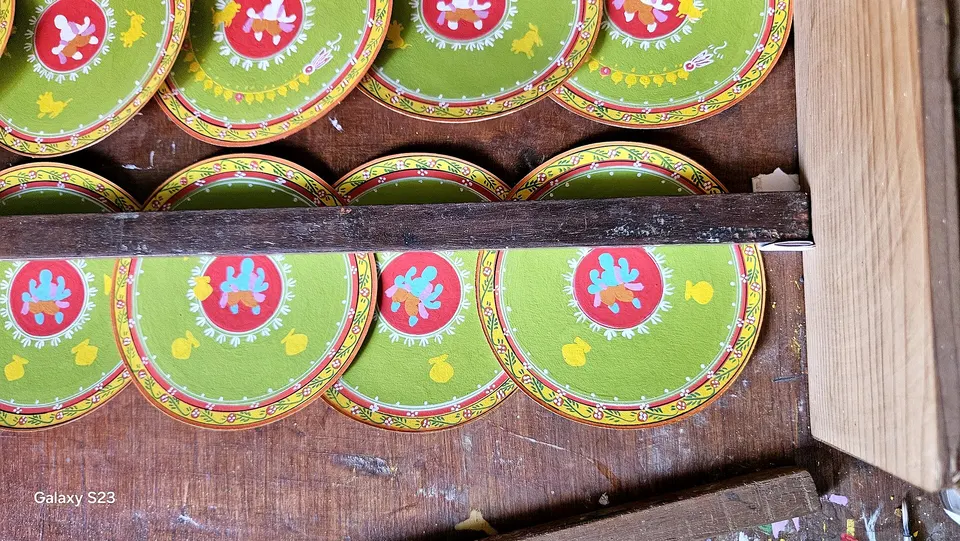
The games probably stayed mostly inside the palace walls. Von Leyden says only a few of them caught on among ordinary people.4 Perhaps that is no surprise. Few families had room on the floor for eighteen suits.
But the cards that survive are something special. Von Leyden counts them among the finest playing cards ever made in India.4
Mysore in the wider world of cards
Mysore also has a place in the story of the better-known Dashavatara game, with its ten suits for the ten forms of the god Vishnu. Different regions put the eighth and ninth suits in different orders. Von Leyden groups Mysore with the southern Deccan, where the eighth suit is Balarama and the ninth is Krishna.3
Sources
Written in our own words from these sources.
- Ganjifa: The Playing Cards of India, Rudolf von Leyden (Victoria & Albert Museum, 1981), p. 12 (plate)
- Ganjifa: The Playing Cards of India, Rudolf von Leyden (1981), p. 15
- Ganjifa: The Playing Cards of India, Rudolf von Leyden (1981), p. 22
- Ganjifa: The Playing Cards of India, Rudolf von Leyden (1981), p. 26
Image credits
- Ganjifa Cards in Preparation · Photo: Art Projects MKCL KF, via Wikimedia Commons · CC BY-SA 4.0
- India, carte per giocare a ganjifa, 1890-1920 ca. 02 · Photo: Sailko, via Wikimedia Commons · CC BY 3.0

