Akbar's twelve-suit pack
Twelve lords of horses, elephants, demons and snakes. Then an emperor decided the kings looked too alike, and changed the pack.
- Region
- India
- Court
- Akbar's court
- Period
- 1500s
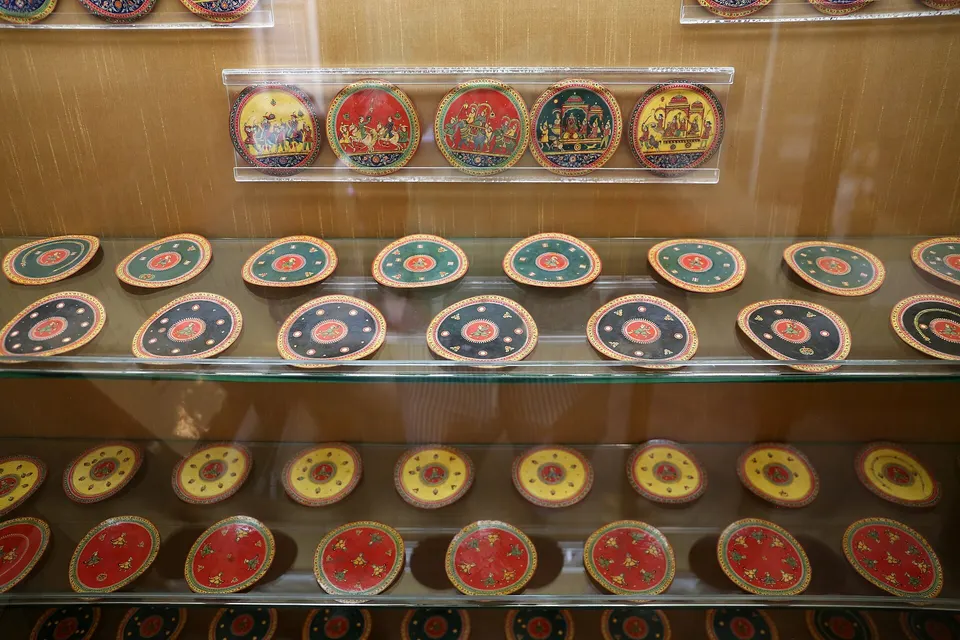
The emperor’s book of games
Imagine being the man whose job was to write down everything an emperor did. Every hunt, every tax, every game. That man was Abu’l Fazl. He was the secretary, the minister (wazir) and the life-story writer of the Mughal emperor Akbar.1
His great book is the Ain-i-Akbari, “the rules of Akbar”. Von Leyden dates it to about 1565. It explains how the whole imperial court was run, and one chapter is all about the emperor’s games.1
The list goes in order. First comes chaugan, which is polo. Then flying pigeons. Then two board games played with dice, chaupar and chandal-mandal. And last of all, described in loving detail, come two packs of cards, called ganjifa or ganjafeh.1
Akbar played chess too, four-handed and two-handed, partly to see what the people around him were made of.1 So cards kept serious company. Von Leyden concludes that by the second half of the 1500s, the court rated a good card game as highly as the old games of chess and chaupar.1
Abu’l Fazl tells a little story. The “ancient sages”, he says, built the game on the number twelve, with twelve cards in every suit. But they never managed to make their twelve kings look different from each other. So Akbar changed the cards and played a game of his own.1
Twelve lords
Here is the old pack. Each suit has a lord, and the names all end in -pati, which means “lord of”. Say them out loud and they sound like a drum roll.2
- Ashwapati, lord of horses. His king is the king of Delhi, on horseback, with an umbrella, a flag and other royal gear.
- Gajapati, lord of elephants. The king of Orissa, riding an elephant.
- Narpati, lord of men. The king of Bijapur on a throne, with foot-soldiers on the number cards.
- Garhpati, lord of forts.
- Dhanpati, lord of treasure, sitting with bags of gold. His sign is jars of coins.
- Dalpati, lord of battle, dressed for war in armour, with armoured warriors all round him.
- Nawpati, lord of the fleet, on a throne on board a ship.
- Tipati, lord of the ladies. Here the “king” is a queen, with maidens around her, and even the minister is a woman.
- Surapati, lord of the gods. The king is Indra, ruler of the heavenly beings.
- Asurapati, lord of the demons. The king is Sulaiman, son of Daud — Solomon, son of David.
- Banpati, lord of the jungle. The king is a tiger, and his minister rides a leopard.
- Ahipati, lord of serpents. A huge snake riding a dragon, with a minister who is a snake sitting on another snake.2
Where does the minister sit? On a horse in the horse suit, on an elephant in the elephant suit, and in most of the others on a chandeli, a small throne.2
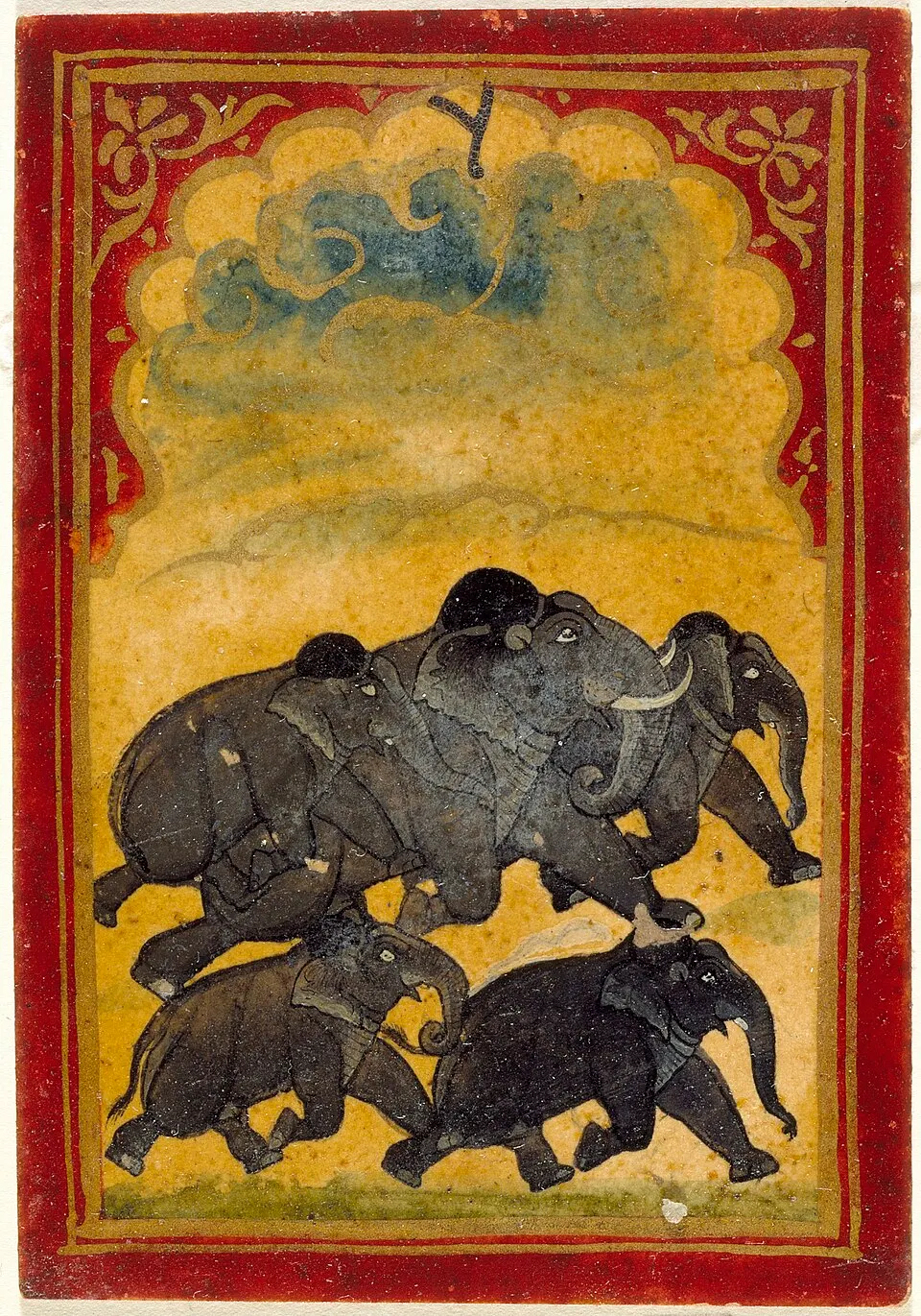
The pack splits neatly in half. Suits 1 to 6 are bishbar, the powerful ones. Suits 7 to 12 are kambar, the weak ones.2
An army with four strange guests
Look at the first eight lords again. Von Leyden sees a complete army there, the kind a great Asian warlord would march with: horses, elephants, foot-soldiers, an armoured guard, forts and ships, a treasury to pay for it all, and the women’s household that travelled with him.2 So, to him, those eight suits make a pack with a military flavour.
The first three even have real names: the Emperor in Delhi, and his governors in Orissa and in Bijapur, down in the Deccan. Von Leyden wonders if this is like French cards, where the court cards were given the names of heroes. Perhaps someone was making the pack personal.2
Then the parade gets weird. The last four suits are gods, demons, wild forest animals and snakes from the world below.3 Indra rules the Hindu heavens. In the Islamic world, Solomon is the master of spirits and jinn. Yet every suit name is pure Sanskrit, completely Indian.3
Von Leyden’s hunch: the twelve-suit game is an Indian makeover of an older war game, with four extra suits borrowed from a totally different world.3 He also finds the mix clumsy and out of tune.2 Abu’l Fazl treats the game as famous. Von Leyden calls it one of the real riddles of Indian card history.3
And those “ancient sages”? Von Leyden suspects the phrase means people thought the game was old, and maybe going out of fashion. That could be why Akbar wanted to change it.2
Akbar’s eight suits
Akbar’s own pack had eight suits. Each king is called Padishah, “emperor”, and each one is busy doing a job at court.3
- The king of gold coins hands out money from his throne.
- The king of documents (barat) reads through papers.
- The king of merchandise (qimash) inspects goods, like yaks from Tibet and silks.
- The king of the harp (chang) has musicians on his number cards.
- The king of silver coins hands out silver.
- The king of swords (shamsher) tests how good a blade’s steel is.
- The king of the crown (taj) gives out royal badges of honour.
- The king of slaves (ghulaman) rides an elephant, and his minister rides in a cart instead of on a chandeli.3
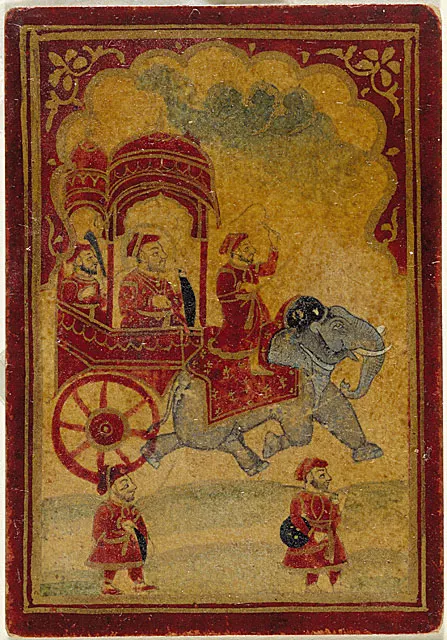
The best part is the number cards. They are not just piles of symbols. They show the people who did the work. The gold suit has jewellers, metal melters, weighers, coin makers and men counting gold mohurs. The documents suit has paper makers, clerks, writers and bookbinders from the imperial office. The sword suit has armourers and polishers. The crown suit has jewellers, quilters and tailors.3
And the slaves suit? Its servants are sitting, or bowing down in prayer, or drunk, or sober. A whole palace staff, on their good days and their bad ones.3
The cards
2 cards
- Barat · King
- Shamsher · 7
The pack everyone copied
Did Akbar really invent this game? Abu’l Fazl says so. But Abu’l Fazl often flattered his master, and von Leyden thinks Akbar probably did not.3 The eight-suit game was a very fancy version of the ordinary ganjifa that Iran also knew. Only the order of the suits and a few names were different.3
What Akbar most likely did was ask his painters to fill every single card with scenes from his own court.3 Sadly, not one of those cards has survived.3
Still, the idea lived on. Akbar’s royal pack, probably painted on ivory by court artists, became the pattern for Mughal ganjifa. Rich patrons and their card painters copied it for generations.3 Today, in most packs, only the ghulam suit keeps those busy little scenes of people at work and play.4
Sources
Written in our own words from these sources.
- Ganjifa: The Playing Cards of India, Rudolf von Leyden (Victoria & Albert Museum, 1981), p. 11
- Ganjifa: The Playing Cards of India, Rudolf von Leyden (1981), p. 12
- Ganjifa: The Playing Cards of India, Rudolf von Leyden (1981), p. 13
- Ganjifa: The Playing Cards of India, Rudolf von Leyden (1981), p. 14
Image credits
- Ganjifa packs on display, made between about 1890 and 1920. · Photo: Sailko, via Wikimedia Commons · CC BY 3.0
- Five Galloping Elephants, Number Six of the Gajpati (Lord of Elephants) Suit, Playing Card from a Mughal Ganjifa Set · Los Angeles County Museum of Art, M.73.55.10 · Public domain
- A Woman with Seven Documents, Number Seven of the Barat (Document) Suit, Playing Card from a Mughal Ganjifa Set · Los Angeles County Museum of Art, M.73.55.6 · Public domain
- A King in an Elephant-drawn Carriage · Los Angeles County Museum of Art (Gift of Mr. and Mrs. Julian Ganz, Jr.) · Public domain
- Barat · King · Los Angeles County Museum of Art, M.73.55.9 · Public domain
- Shamsher · 7 · Los Angeles County Museum of Art, M.73.55.11 · Public domain

_Suit,_Playing_Card_from_a_Mughal_Ganjifa_Set_LACMA_M.73.55.10.jpg)
_Suit,_Playing_Card_from_a_Mughal_Ganjifa_Set_LACMA_M.73.55.6.jpg)

_Suit,_Playing_Card_from_a_Mughal_Ganjifa_Set_LACMA_M.73.55.9.jpg)
_Suit,_Playing_Card_from_a_Mughal_Ganjifa_Set_LACMA_M.73.55.11.jpg)