Ganjappa
Odisha's own ganjifa: flowers for crowns, the sun and moon for money, and Lord Jagannatha in the pack.
- Region
- Odisha (once spelled Orissa)
- Court
- Sonepur, Puri, Chikiti and village painters
- Period
- Still painted today
Origins
Say ganjifa in Odisha and you might hear it come back as ganjappa, or ganjipa. It is the same word, worn smooth by a different tongue.2 (When von Leyden wrote, the state was spelled Orissa; today it is Odisha.)
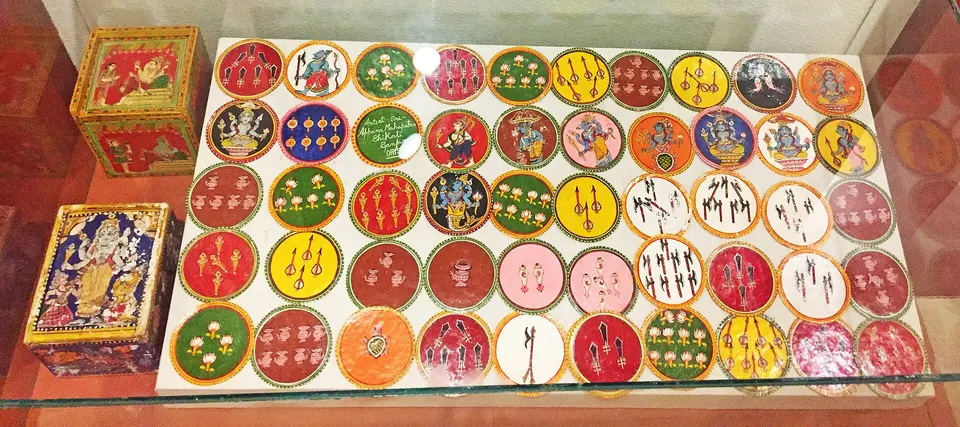
The cards came from the Mughal pack, and in Odisha they were made over in a local style. The painters kept the old suits, but changed what they looked like. Their kings and ministers became Hindu gods and heroes.1
Odisha’s eight-suit pack even has its own name: ath rangi sara, “the eight-colour set”.1
The pack, Odisha style
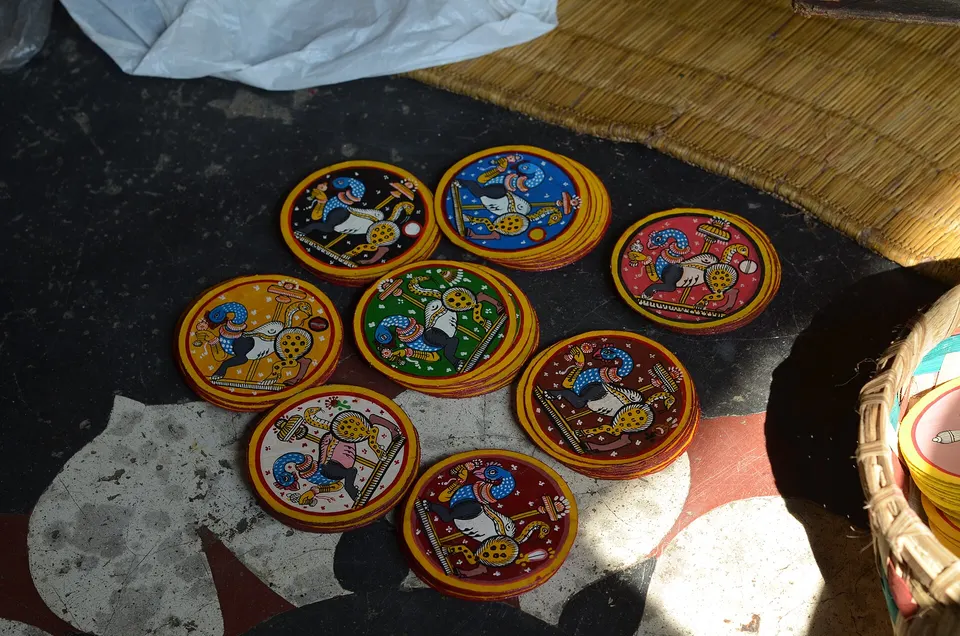
Here the painters had fun. Look closely at an Odisha pack and the familiar Mughal suits turn into something new:1
- The gold and silver money suits are named surya and chandra: the sun and the moon.
- The crown suit blossomed into a flower, so the suit’s name became fula, which means flower.
- The document suit’s sign became a circle with a white band across it.
- Swords can be the straight khanda blade instead of the curved sabre.
The best mix-up happened at Puri. Someone heard the servant suit’s name, gulam, as gulab, which means rose-water. So in Puri that suit’s sign became a red flower.1
How it was played
Odisha’s Brahmin households loved these cards, and von Leyden says they were still playing on afternoons, sitting in small temple halls.2
One Odisha game is called Ekrang, “one colour”. It is played by two teams of two, partners against partners.3 The word turns up in a second way too: Odisha has special packs where every card is the same colour and the same suit, and these packs are also called ekrang.2
In 1922 the Maharaja of Sonepur, in Odisha, wrote down clear rules for two games: Hamrang and Ekrang.4
The biggest packs of all
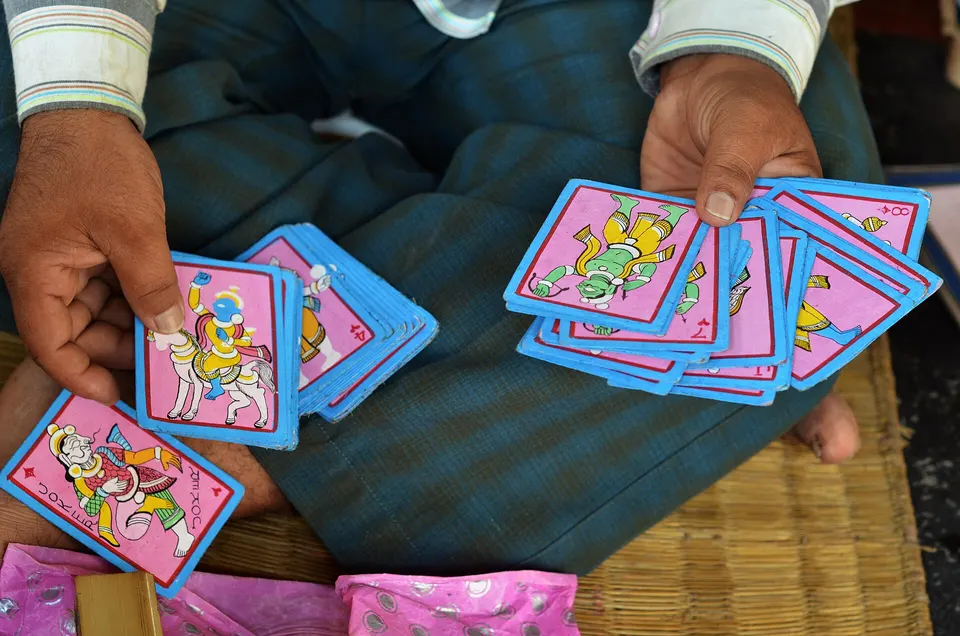
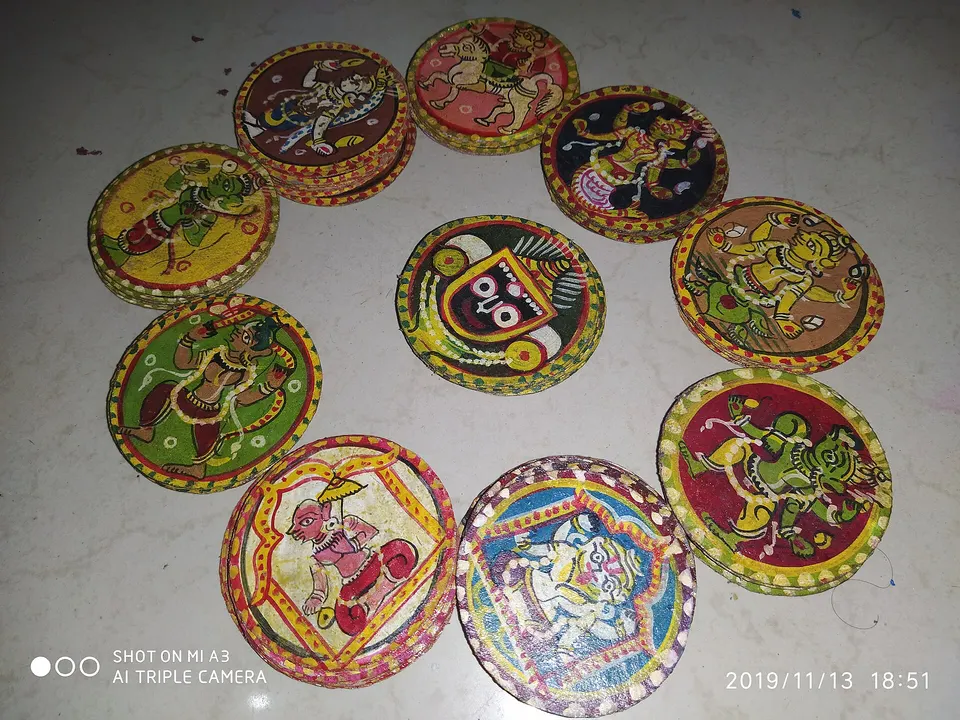
Odisha’s card makers never seemed to think a pack was big enough. They took the ten-suit pack of Vishnu’s avatars and added Ganesha and Skanda to make twelve suits, then more gods for sixteen or even twenty.2
And in Sonepur they painted a twelve-suit Ramayana pack: six suits for Rama’s army against six for the demon king Ravana. Every game was a battle from the epic, fought one card at a time.2 Many Hindu-themed packs were tried across India, but this Ramayana pack is the one that survived, in Odisha.1
Where it is made today
Painted ganjapa has not vanished. You can find full sets in Odisha’s museums, and painters still make them by hand, circle by circle, in bright colours.
Sources
Written in our own words from these sources.
- Ganjifa: The Playing Cards of India, Rudolf von Leyden (Victoria & Albert Museum, 1981), pp. 15–20
- Ganjifa: The Playing Cards of India, Rudolf von Leyden (1981), pp. 22–28
- Ganjifa: The Playing Cards of India, Rudolf von Leyden (1981), p. 40
- The game of ganjifa, Michael Dummett, appendix in von Leyden (1981), p. 50
Image credits
- Ganjapa cards and their painted boxes at the Odisha Crafts Museum, Bhubaneswar. · Odisha Crafts Museum, Bhubaneswar · Photo: Subhashish Panigrahi, via Wikimedia Commons · CC BY-SA 4.0
- Atharangi Ganjapa · Photo: Subhashish Panigrahi, via Wikimedia Commons · CC BY-SA 4.0
- Jagannatha card from a Dashabatara ganjapa set, Paralakhemundi · Cropped by Tashkhela from a photo by bishnu Mohan adhikari (cards drawn by simanchala bindhaniratna), via Wikimedia Commons · CC BY-SA 4.0
- Carirangi Ganjapa · Photo: Subhashish Panigrahi, via Wikimedia Commons · CC BY-SA 4.0
- Dashabatara Ganjapa , Paralakhemundi · Photo: Photo taken by bishnu Mohan adhikari Drawn by simanchala bindhaniratna, via Wikimedia Commons · CC BY-SA 4.0


