When European cards came to India
Sailors brought cups and swords, the British brought spades. India painted them all over again, sometimes round.
- Region
- Coastal India, the Deccan, Rajasthan and beyond
- Court
- Goa, Mysore, Kashmir, Sawantwadi and Orissa
- Period
- From the 1500s
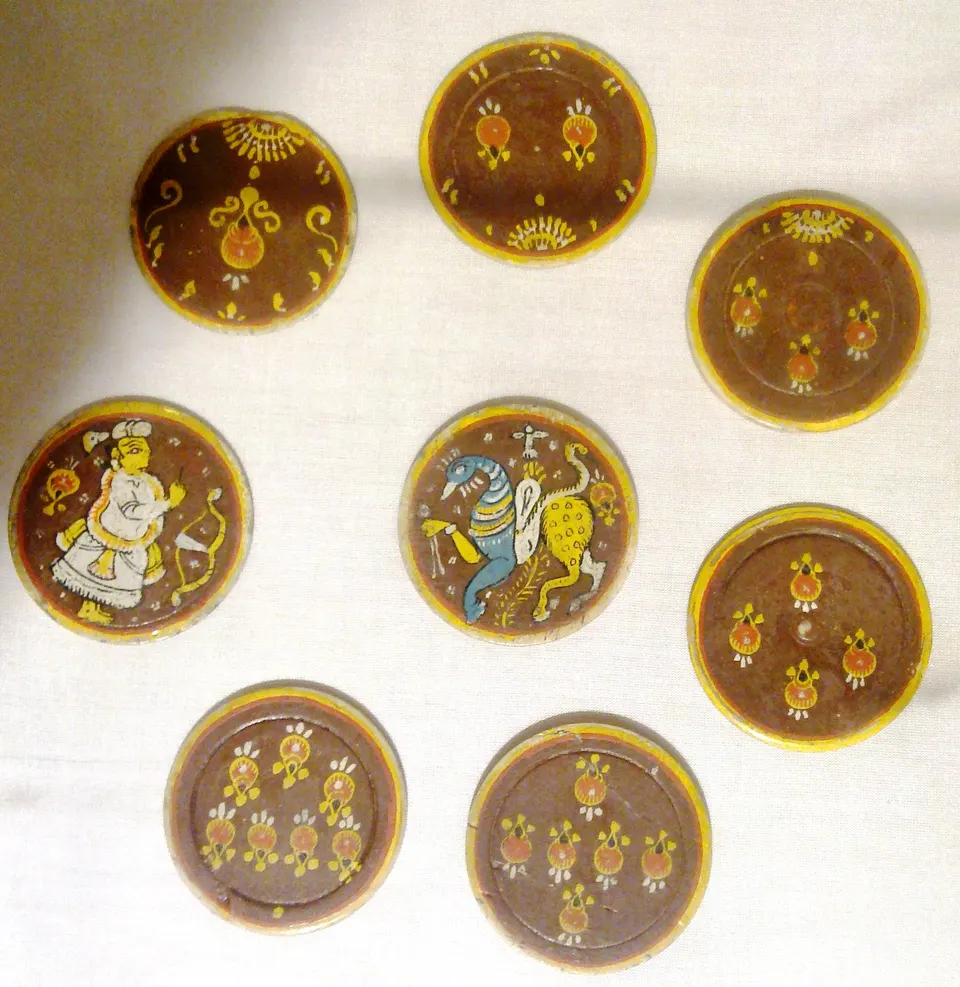
Ships, spices and a pack of cards
Picture a wooden ship that has sailed all the way around Africa. It is May 1498, and it drops anchor at Calicut, on India’s south-west coast. The Portuguese on board want spices, and they want to get them without paying the Arab and Turkish traders in the middle.1
They moved fast. In about twelve years they had a whole ring of forts and harbours around the Indian Ocean. Goa became theirs in 1510.1
And in the sailors’ pockets? Cards, of course.
The saint who held the cards
In 1542 a priest named Francis Xavier sailed to India to spread his faith. He was not pleased with the crew. The Portuguese sailors kept gambling at cards, and he could not get them to stop.1 (The book’s timeline puts this in 1548, though its main text links it to his voyage of 1542.)5
So what did the saint do? He gave up arguing and simply watched. Sometimes he even offered to hold a player’s cards for him.1 If you cannot beat them, mind their hand.
Their cards looked nothing like ganjifa. A Portuguese pack had four suits, the old Italian and Spanish kind: cups, swords, coins and staves (heavy sticks). Each suit had three picture cards, the re (king), the cavalo (horseman) and the sota (a servant). In some coastal parts of India, people must have known these cards well by the 1500s.1
Von Leyden paints a lovely double picture. Far inland, the emperor Akbar plays his eight-suited ganjifa in his palace at Fatehpur Sikri. Down on the coast, in the seaside taverns of Goa, Portuguese sailors play a game called Ombre.1 Ombre was a Spanish game, and for a long time it and its relatives were the most fashionable card games in all of Europe. It used a pack of 40 cards.6
Indian painters copy the foreigners
The Portuguese traded with Indian kings, above all in Arabian horses. That brought them face to face with the rulers of Vijayanagar, the sultans of the Deccan and the Rajput princes of Rajasthan.3
Those nobles noticed the strange new cards and liked them. So they did what any rich card fan would do: they ordered copies, painted by Indian artists in Indian styles.3 In the Deccan and Rajasthan, painters made 40-card Ombre packs with the four Portuguese suits, which had their own names: cups were copa, swords espados, gold coins ouros, and staves bastoes.3 Von Leyden is sure these copies were really made and really played by the nobility there.1
His book shows four such cards in a row: four coins, some swords, four knobbly staves and two cups with lids, each sitting under a pointed, scalloped arch on a dark background.1
But here is the surprise. Von Leyden is fairly confident that the European cards had nothing to do with how ganjifa itself began. The eight-suited pack, he says, has its roots in Iran and Central Asia.1 Dummett, who wrote the book’s appendix on how ganjifa is played, agrees in his own way. Ganjifa has no trump suit, and he points out that trumps were a European invention, which confirms that ganjifa did not come from a European game.6
Spades become black almonds
The Portuguese were only the first. Traders, officials and soldiers from all over Europe arrived with their own cards and games, and Indians soon made European-style cards in their own way.2
From the 1700s, French and English packs got the same treatment. Painters redid them in Indian styles, and sometimes they even made them round, like ganjifa. Von Leyden names Mysore, Kashmir, Sawantwadi and Orissa as places where this happened.3 The book shows one card from such a pack: a seven from a French-style piquet pack, made in Mysore or Tanjore.3 And in his day you could still walk into a shop in Puri and buy cards with western suit signs and Indian figures on them.3
The suits got Indian names too, and they are a small poem:4
- Spades were hukum (the trump), ispede (from “spade”) or kali padam, the “black almond”.
- Hearts were pan, the pan leaf, or lal pal, “red heart”, or lal padam, “red almond”.
- Diamonds were chaukat lal, “red square”, or chokedi, “farm yard”.
- Clubs were fuli or fulewar, both meaning flower, or chiriya, “bird”.
So a club could be a flower or a bird, depending on who was looking. Not bad for a little black blob.
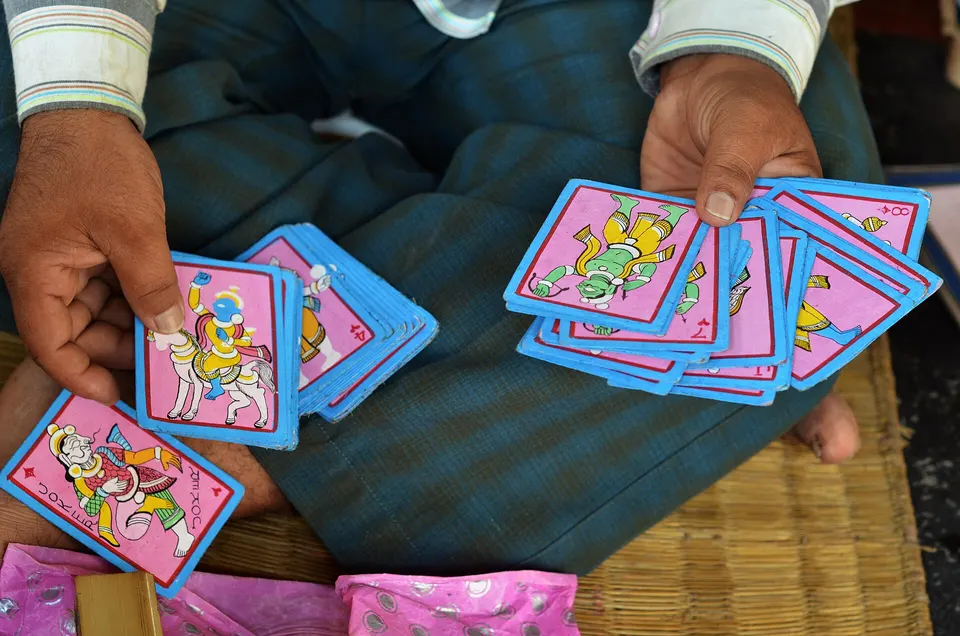
Cheap paper and empty paintbrushes
Then the flood came. In the 1800s India was swamped with printed cards from England, Germany and Belgium, and later from Japan.3 Belgian makers kept trying to sell Indians packs with Indian figures on them, but none of those designs caught on.3
Printed cards were cheap, and there were lots of them. First they came from Europe, and later Indian presses printed them too. The old painted games faded away, and the chitrakars, the families of card painters, lost their customers.2
Even the imported cards were not wasted. Paper was precious, so people used the old cards for notes and drawings. A Brahmin artist named Sadanand, from Cambay, painted his pictures on the backs of English playing cards.4
By 1981, when von Leyden wrote, India printed its own cards, but nearly all of them used the international pattern, which comes from old French cards and has nothing to do with Indian tradition.3 He ends with a wish: that one day Indian designers will draw on ganjifa and make popular cards that look like India.3
Sources
Written in our own words from these sources.
- Ganjifa: The Playing Cards of India, Rudolf von Leyden (Victoria & Albert Museum, 1981), pp. 7–8
- Ganjifa: The Playing Cards of India, Rudolf von Leyden (1981), p. 15
- Ganjifa: The Playing Cards of India, Rudolf von Leyden (1981), p. 28
- Ganjifa: The Playing Cards of India, Rudolf von Leyden (1981), page on European cards in India (printed number not visible)
- Ganjifa: The Playing Cards of India, Rudolf von Leyden (1981), p. 41
- The game of ganjifa, Michael Dummett, appendix in von Leyden (1981), pp. 50–53
Image credits
- Painted Indian playing cards at the National Museum, New Delhi. · National Museum, New Delhi · Photo: juggadery, via Wikimedia Commons · CC BY-SA 2.0
- Ganjapa · Photo: Vaigupta, via Wikimedia Commons · CC BY-SA 4.0
- Carirangi Ganjapa · Photo: Subhashish Panigrahi, via Wikimedia Commons · CC BY-SA 4.0
- Ganjifa Cards in Preparation · Photo: Art Projects MKCL KF, via Wikimedia Commons · CC BY-SA 4.0
.jpg)


