Ganjifa
Round cards, painted by hand, played by emperors. A game where forgetting one card can cost you everything.
- Region
- Iran and India
- Court
- Safavid and Mughal
- Period
- From about 1500
Origins
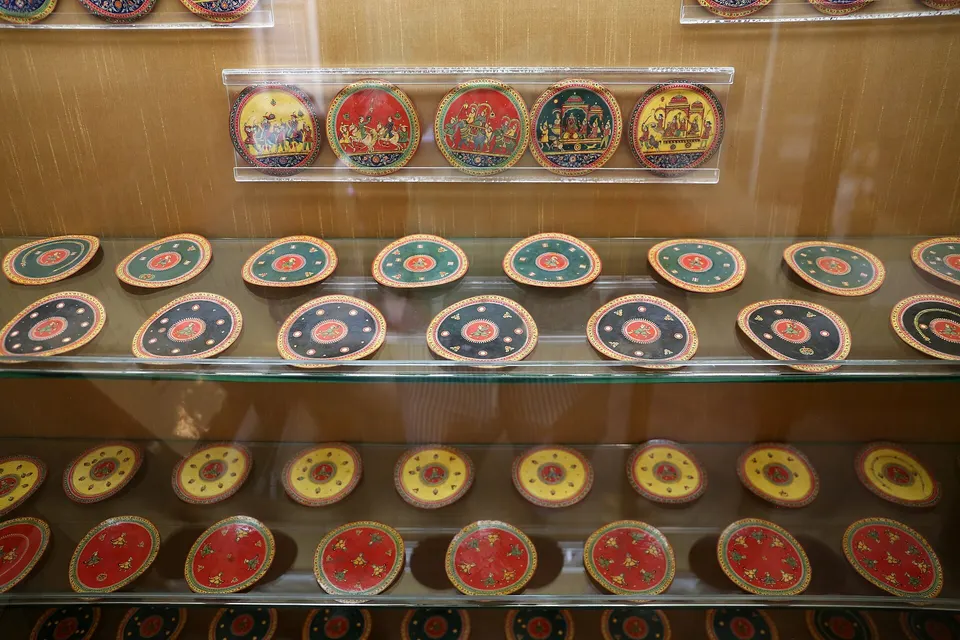
Imagine a deck of cards you could not buy in a shop. Each card is round and painted by hand. A whole pack has 96 of them. That pack is ganjifa.
Where does the name come from? Nobody knows for sure. In Persian, ganj means treasure, and a pack of painted cards certainly was one. But the word ganjifa itself may have come from another language and changed shape on the way.1
The cards turn up around the year 1500, in Iran and in India at the same time. Kings loved them. In 1514 a poet called Ahli Shirazi wrote 96 little love poems, one for every card in the pack. They tell us almost nothing about how to play — he was busy being in love — but they are the oldest writing that names all eight suits.1
“The night we left Agra Mir ‘Ali the armourer was sent to Shah Hasan (Arghun) in Tatta to take him playing-cards [ganjifa] he much liked and had asked for.”
So even an emperor on the march found time to post a pack of cards to a friend. A few years later, his daughter Gulbadan wrote about a royal party where twelve players sat down with 20 cards each, betting copper coins. That is 240 cards on the carpet at once.2
Then something odd happened. In Persia, a stern shah named Abbas II banned the game in the 1600s, and it vanished there. In India it did the opposite: it grew.2
The great emperor Akbar played cards as seriously as he played chess. His writer Abu’l Fazl tells us Akbar even redesigned a pack, because he thought its twelve kings were too much alike.2
How it was played
Three players sit in a circle. Every single card is dealt out, and the game travels around the circle the opposite way to a clock.45
Who goes first? That depends on whether the sun is up. One special king card starts the game by day, and a different king by night.5
Each turn, the leader puts down a card and the others answer with one card each. The best card of the suit that was led wins the trick. There are no trumps, and you do not have to follow suit. If you cannot win, you just throw away a card you don’t need.5
Now the clever bit. The highest card still left in a suit is called the hukm, meaning “the command”. If you hold the hukm and that suit is led, you must play it. Forget, and your mighty card is “burned”: it drops to the very bottom of its suit.5
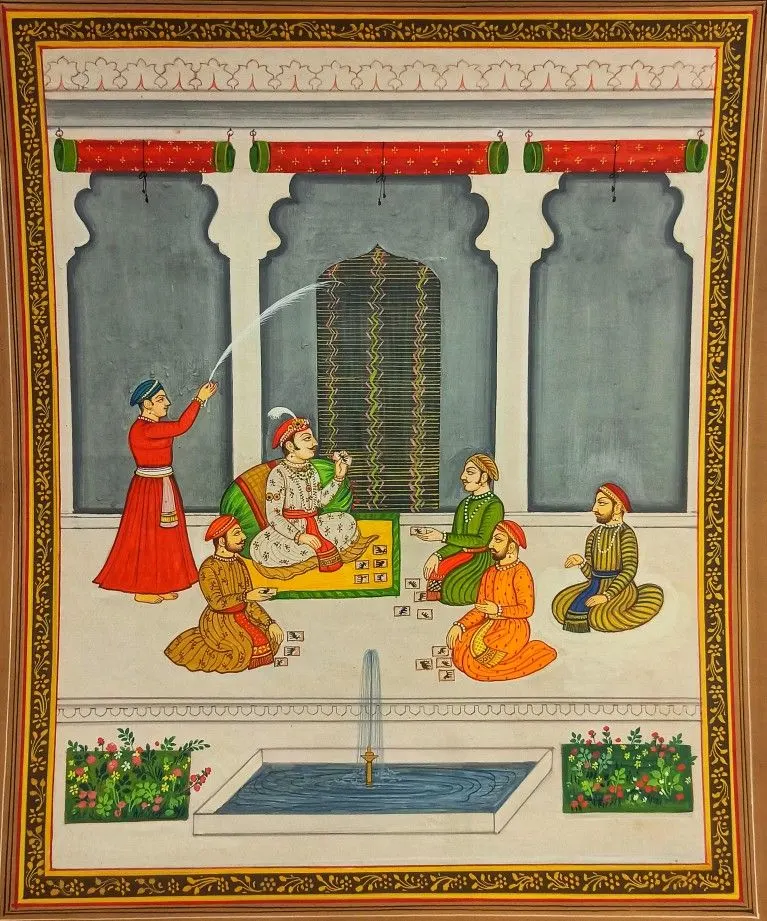
So ganjifa is a memory game in disguise. To win, you have to remember every card that has already been played.4
The suits and their meaning
A Mughal pack has eight suits of twelve cards. Each suit has a king, a minister called the wazir, and ten number cards.2
Some suits are strong and some are weak. In a weak suit, the ace beats the other numbers. In a strong suit, it is the ten that wins. Yes, it is upside down. You get used to it.2
The suits are like a tour of an emperor’s palace:23
- Surkh, red, is gold coins, and safed, white, is silver coins. Later people said they stood for the sun and the moon.1
- Taj is the crown.
- Shamsher is the curved sword.
- Ghulam is the household: servants, courtiers and entertainers.
- Chang is the harp, for the musicians.
- Barat is the royal paperwork.
- Qimash is the storeroom of goods.
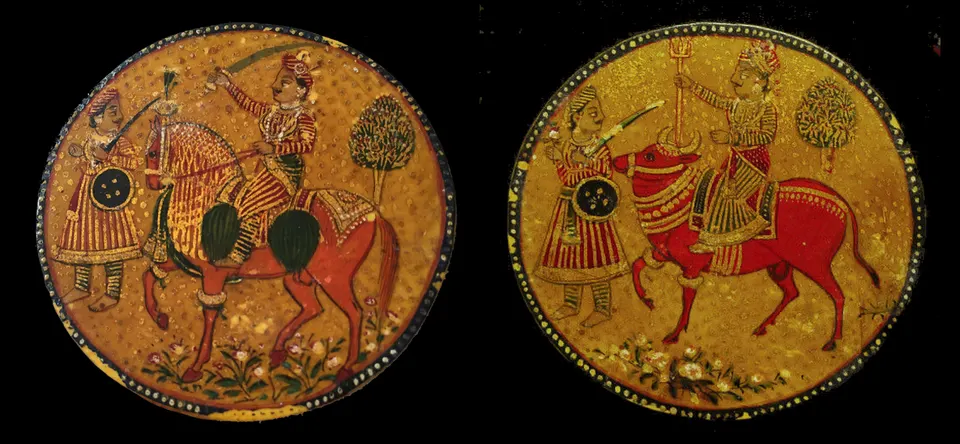
The ghulam cards are often the most fun to look at. Instead of symbols, they show tiny people busy with their day, and you count the people to know what the card is worth. Their king always rides an elephant. Their minister rides in a cart pulled by a bullock.3
The cards
4 cards
- Barat · King
- Barat · 7
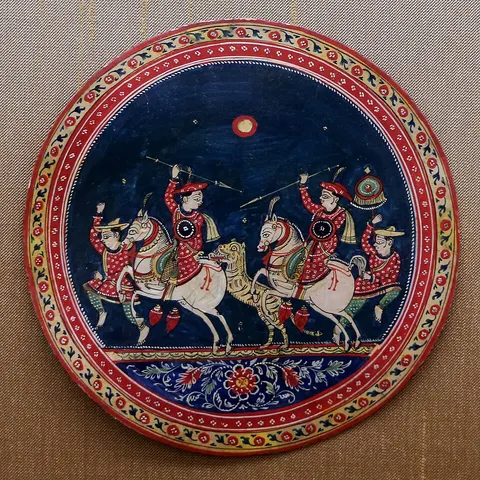
- Shamsher · 7
- Card, 1890–1920
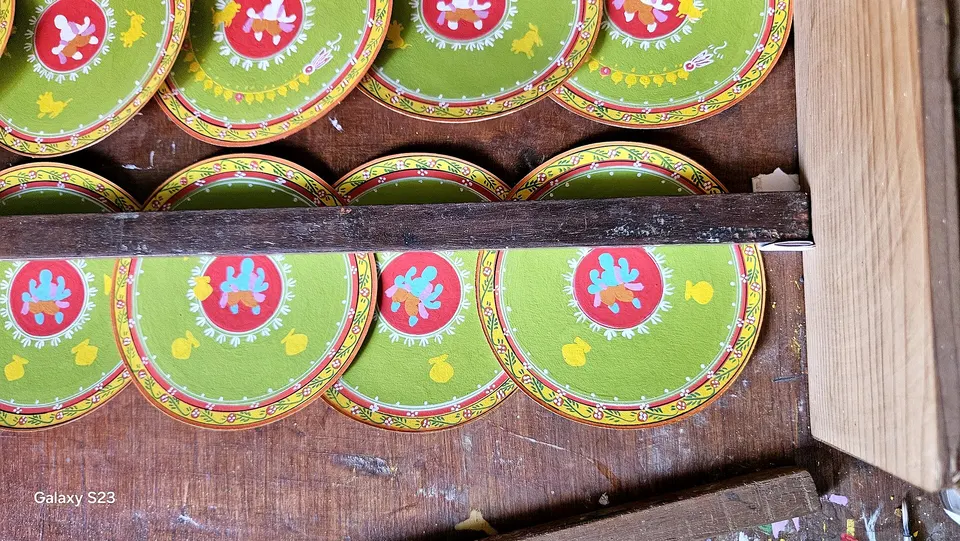
Where it is made today
For centuries, these cards were painted by families of artists called chitrakars. Then printed paper cards arrived, first from Europe and later from Indian presses. They were cheap, and the old painted games slowly faded. When von Leyden wrote his book in 1981, the painters had lost most of their customers.2
Sources
Written in our own words from these sources.
- Ganjifa: The Playing Cards of India, Rudolf von Leyden (Victoria & Albert Museum, 1981), pp. 5–8
- Ganjifa: The Playing Cards of India, Rudolf von Leyden (1981), pp. 11–17
- Ganjifa: The Playing Cards of India, Rudolf von Leyden (1981), pp. 18–21
- Ganjifa: The Playing Cards of India, Rudolf von Leyden (1981), pp. 40–41
- The game of ganjifa, Michael Dummett, appendix in von Leyden (1981), pp. 50–58
Image credits
- Ganjifa packs on display, made between about 1890 and 1920. · Photo: Sailko, via Wikimedia Commons · CC BY 3.0
- Maharaja Raj Singh II of Mewar, playing Ganjifa in the palace, circa 18th century CE, Rajasthani School of Art, INHCRF Coin Museum, Nashik, Maharashtra · INHCRF Coin Museum, Nashik · Photo: SpeakingArch, via Wikimedia Commons · CC BY-SA 4.0
- Shamsher · 7 · Los Angeles County Museum of Art, M.73.55.11 · Public domain
- Mughal Ganjiya Playing Cards, Early 19th century, courtesy the Wovensouls collection · Wovensouls collection · Photo: Jainamishra, via Wikimedia Commons · CC BY-SA 4.0
- Barat · King · Los Angeles County Museum of Art, M.73.55.9 · Public domain
- Barat · 7 · Los Angeles County Museum of Art, M.73.55.6 · Public domain
- Card, 1890–1920 · Photo: Sailko, via Wikimedia Commons · CC BY 3.0
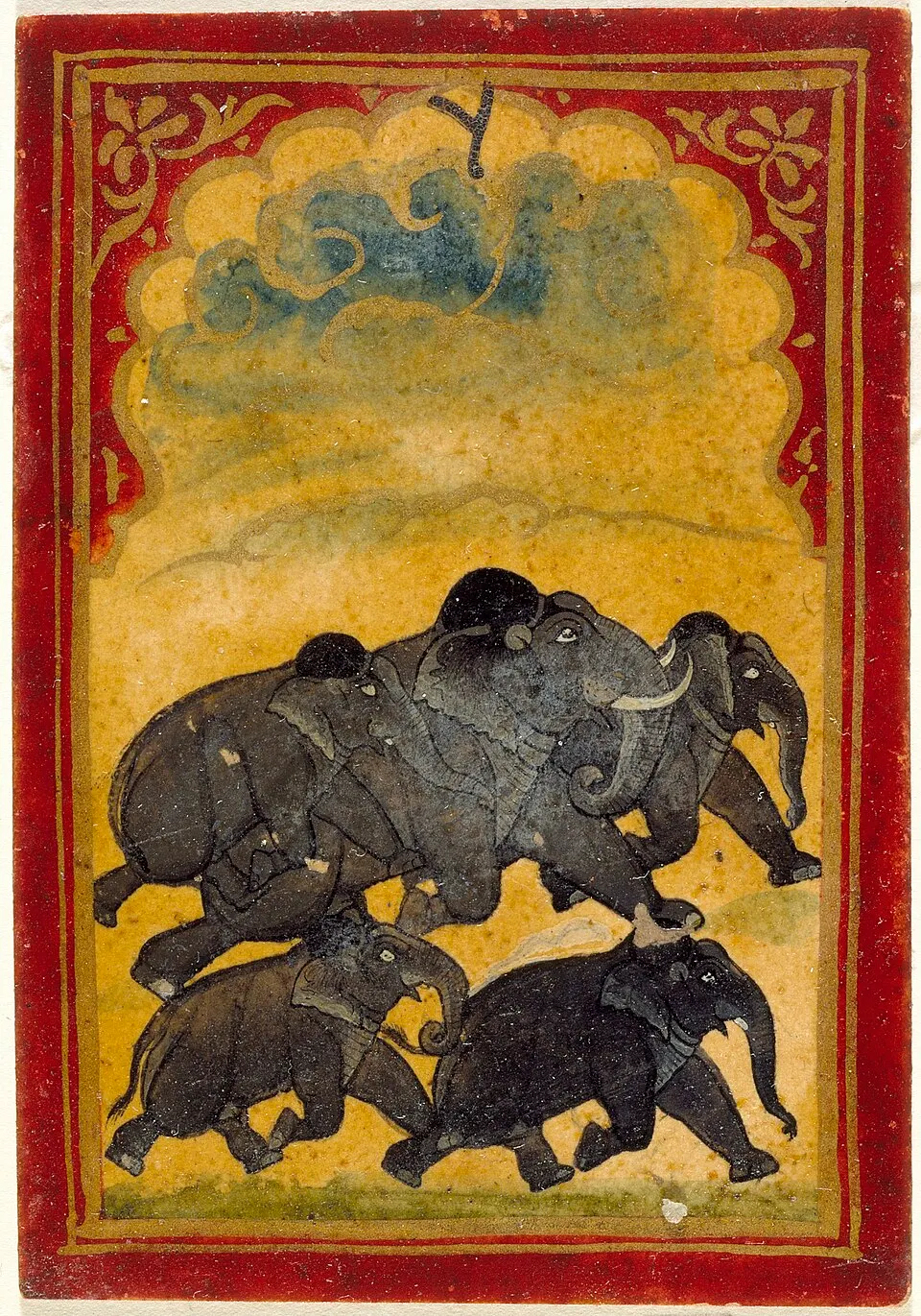
- Five Galloping Elephants, Number Six of the Gajpati (Lord of Elephants) Suit, Playing Card from a Mughal Ganjifa Set · Los Angeles County Museum of Art, M.73.55.10 · Public domain
- Ganjifa Cards in Preparation · Photo: Art Projects MKCL KF, via Wikimedia Commons · CC BY-SA 4.0


_Suit,_Playing_Card_from_a_Mughal_Ganjifa_Set_LACMA_M.73.55.11.jpg)

_Suit,_Playing_Card_from_a_Mughal_Ganjifa_Set_LACMA_M.73.55.9.jpg)
_Suit,_Playing_Card_from_a_Mughal_Ganjifa_Set_LACMA_M.73.55.6.jpg)

_Suit,_Playing_Card_from_a_Mughal_Ganjifa_Set_LACMA_M.73.55.10.jpg)
